🚩 What Is the Flag Challenge?
Every country on Can Do Kids Worldwide has a flag waiting to be earned.
The Flag Challenge is a short, friendly game attached to each country page. Choose a country, play four quick rounds about it, and the country's flag is added to your My Flags collection.
It is a simple idea, and that is the point. A flag is one of the first things a child can recognise about a country — its colours, shapes and symbols. The challenge turns that recognition into a reason to learn the facts that go with it: where the country is, what its capital is called, what money people use, and what language they speak.
Think of it as collecting, with learning built in.
🎮 How It Works
Open any country page, scroll to Play, and choose Flag Challenge.
Each challenge has four rounds. The flag round comes first: the country's flag is hidden behind a question mark, and four flags are offered. Which one belongs to the country?

Round 1: Which flag belongs to Brazil? Four flags, no labels — you have to look carefully.
Notice that the options are not labelled. Children have to look carefully at the flags themselves — the colours, the patterns, the symbols — rather than reading their way to the answer.
After the flag round, the questions widen out. Depending on the country, children are asked about its:
- Capital — What is the capital of Brazil? (Brasília)
- Currency — What currency is used in Brazil? (the Brazilian Real)
- Language — Which language is spoken in Brazil? (Portuguese)
- Population — About how many people live there?
- Map — For some countries, which map shows its shape?
A progress bar at the top fills up round by round, so children can always see how close they are to earning the flag.
A good way to start: explore the country first. Watch the country video, read the Explorer's Guide and look through the country facts on the country page — that is where the answers are learned. Then take the challenge and put that knowledge to work.
✅ Keep Guessing — There Is No Losing
There are no lives, no timers and no score to lose.
If a child picks the wrong flag, the game simply says "Not quite — good try," marks that option with a red cross, reveals which country it actually belongs to, and invites them to keep guessing until they find the right one. A wrong answer is information, not failure: it rules out one flag, teaches another, and gives a reason to look more closely at the rest.

Not quite! That was Luxembourg. Three flags left — keep guessing.
When the right answer is found, it is confirmed with a Correct, the flag is revealed in full, and the country is named, so the correct answer is the last thing the child sees before moving on.

Correct! The Brazil flag is revealed and named before the next round.
That gentle design matters. Children who are afraid of getting an answer wrong often stop trying. Children who know they can keep guessing keep looking, keep comparing, and keep learning.
🏆 Earn the Flag
Finish all four rounds and the country is yours:
"Amazing! You earned the Brazil flag!"

Completing all four rounds earns the country's flag, with its key facts to keep.
The completion screen also gathers the country's key facts together in one place — a small, satisfying summary of what has just been learned. From there, children can play again, or head to My Flags to see what they have collected.
🗺️ Build Your Flag Collection
My Flags is where the collecting happens. Every country's flag is shown, grouped by region — Africa, the Americas, Asia, Europe, Oceania, the Caribbean and West Asia.
Flags already earned stand out in full colour with a green Earned badge. Flags still to earn are marked Challenge start: choosing one takes you to that country page first, so you can explore the country before you try to earn its flag.
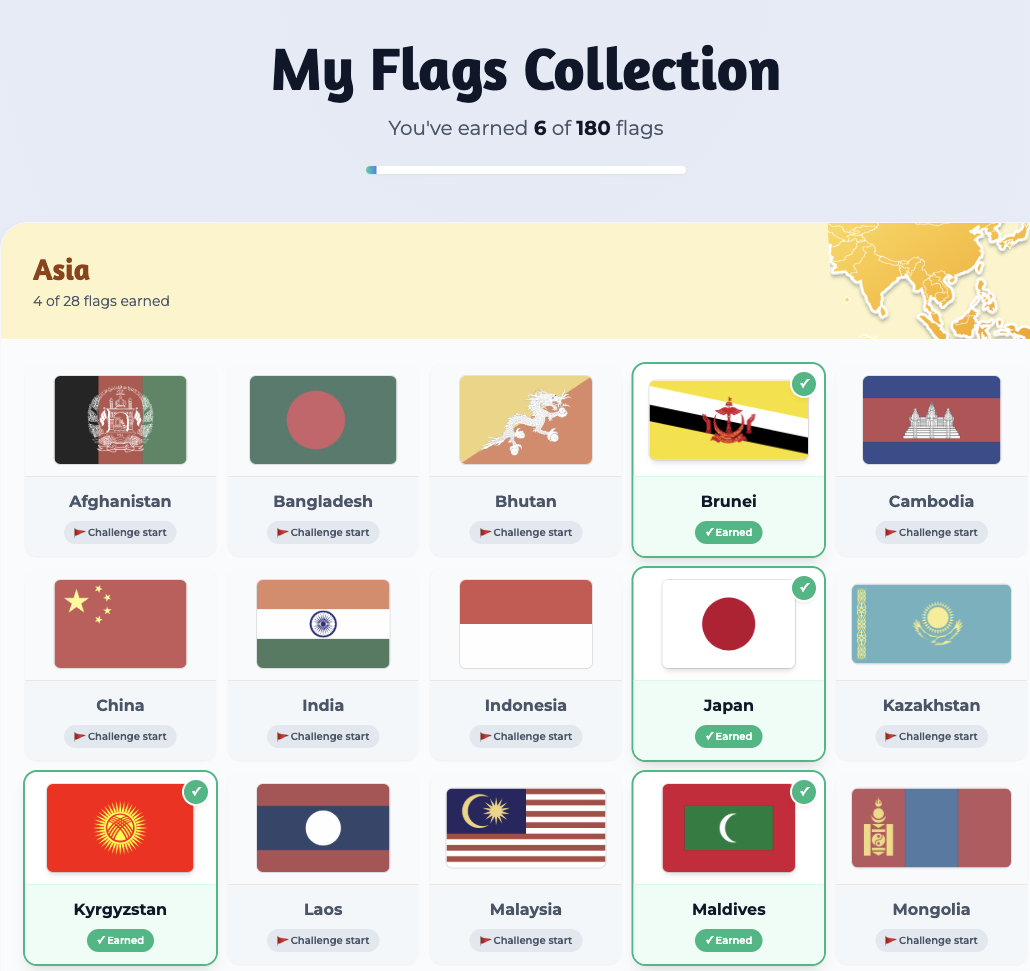
My Flags: a growing collection, region by region. How many can you earn?
With 180 flags to collect, there is always a next country to aim for. That is the collector's feeling working for learning, in the same way passport stamps do: every flag earned is visible proof of a place explored, and an invitation to find the next one.
👩🏫 In the Classroom and at Home
The Flag Challenge fits naturally into a lesson or a few spare minutes:
- Start a country topic by exploring the country page together, then let students take its Flag Challenge individually or in pairs.
- Use it as a finisher — four rounds take only a few minutes, and the progress bar makes it easy to stop and continue later.
- Talk about the near misses. When a flag is confused with another country's, ask what is similar and what is different. Comparing flags is real geography: colours, symbols, stars, crosses and stripes all have stories.
- At home, families can work through a region together and watch the collection grow, one flag at a time.
However it is used, the pattern is the same: explore a country, play the challenge, earn the flag. Curiosity first, facts along the way, and a collection to be proud of at the end.
❓ Flag Challenge FAQs
What is the Flag Challenge?
The Flag Challenge is a four-round geography game on Can Do Kids Worldwide. For each country, children identify its flag, then answer questions about its capital, currency, language, population or map. Completing all four rounds earns that country's flag for their My Flags collection.
How do you play the Flag Challenge?
Open any country page on Can Do Kids Worldwide, scroll to Play, and choose Flag Challenge. In round 1, choose the country's flag from four unlabelled flags. Then answer three more rounds about the country. A progress bar shows how many rounds are complete.
What happens if you choose the wrong flag?
Nothing bad. The game says "Not quite — good try", marks the wrong flag with a red cross, reveals which country it belongs to, and lets you keep guessing until you find the right flag. There are no lives, timers, or scores to lose.
How do you earn a flag?
Finish all four rounds of a country's Flag Challenge and its flag is added to your My Flags collection, marked Earned with a green tick. Exploring a country fully — its Explorer's Guide, crossword, word search and quiz — also earns its flag.
How many flags are there to collect?
There are 180 country flags to collect on Can Do Kids Worldwide. In My Flags they are grouped by region: Africa, the Americas, Asia, Europe, Oceania, the Caribbean and West Asia.
Who is the Flag Challenge for?
The Flag Challenge is designed for primary school students aged about 7 to 12. Teachers can use it in class to start or finish a country topic, and families can play it at home with a Can Do Kids Worldwide account.
Ready to earn your first flag?
Explore a country, take its Flag Challenge, and start your collection.
Classroom Activity Idea
Have students explore one country page first (video, Explorer's Guide and country facts), then take its Flag Challenge and try to earn its flag. Afterwards, they should be ready to answer:
- What does the country's flag look like — and what do its colours or symbols show?
- What is the capital city?
- What currency and language are used there?
Extension: Students choose a flag they confused with another country's and draw both flags side by side, labelling one similarity and one difference. Then they check their progress on the My Flags page: which region will the class complete first?